
AS9100 & AS9120 Certification Consulting for Aerospace, UAV and Defence Supply Chains
________________________________________________________________
Become an approved aerospace supplier. Win defence contracts. Build a quality system your customers trust.
AS9100 is the internationally recognised Aerospace Quality Management System standard for organisations that design, manufacture, or support aviation, space, and defence products — including drones, UAVs, UAS, and eVTOL aircraft. AS9120 is its counterpart for aerospace parts distributors and stockists. Vektors brings 24+ years of management systems consulting experience to guide manufacturers, drone start-ups, precision engineering companies, and distributors across India and internationally through gap assessment, documentation, training, internal audits, and certification support.
Request a Techno-Commercial Proposal → | Call +91-9820444925
_________________________________________________________________
What Are AS9100 and AS9120? An Introduction to Aerospace Quality Standards
AS9100 (current edition: AS9100D, aligned with ISO 9001:2015) is the Quality Management System standard for organisations involved in the design, development, production, and servicing of aviation, space, and defence products. AS9120 (current edition: AS9120B) applies the same aerospace discipline to stockist distributors — organisations that procure and resell aerospace parts, components, and materials without altering them.
Both standards are developed by the International Aerospace Quality Group (IAQG) and published by SAE International, with harmonised equivalents in Europe (EN 9100/9120) and Asia-Pacific (JISQ 9100). Each incorporates the complete text of ISO 9001:2015 and adds aerospace-specific requirements: product safety, configuration management, counterfeit parts prevention, first article inspection linkage, risk-based operational planning, and enhanced supplier control. An AS9100 or AS9120 certificate therefore demonstrates conformity to ISO 9001 and the aerospace supplement in a single, globally recognised certification.
Certification is granted only by accredited certification bodies operating under the IAQG’s Industry Controlled Other Party (ICOP) scheme, and certified organisations are listed in the IAQG OASIS database — the register aerospace primes and defence buyers consult directly when approving suppliers.
Standards update (2026): The IAQG is revising the 9100 series, to be rebranded IA9100, in alignment with ISO 9001:2026. Publication is targeted for late 2026, with a transition window of two to three years expected. Organisations certifying to AS9100D today will transition through normal surveillance cycles — there is no advantage in waiting.
Why Aerospace Quality Standards Matter
Aerospace is unforgiving of quality failure. A single nonconforming fastener, an untraceable electronic component, or an undocumented design change can ground a fleet, void an airworthiness approval, or cause loss of life. Aerospace quality standards exist to manage exactly these risks:
- Safety — flight-critical products demand documented product-safety planning across the entire lifecycle, from design intent to post-delivery support.
- Reliability — consistent processes, validated special processes, and controlled changes produce hardware that performs identically every time.
- Traceability — serial- and lot-level traceability enables airworthiness investigations, targeted recalls, and counterfeit detection.
- Risk management — risk-based thinking is embedded in operational planning, supplier selection, and design decisions, not confined to a register.
- Regulatory compliance — the discipline of an Aerospace Quality Management System directly supports DGCA type certification in India, EASA UAS requirements in Europe, and FAA expectations in the United States.
- Customer confidence and supply-chain access — aerospace primes, defence ministries, and Tier-1 suppliers flow AS9100/AS9120 requirements down through their supply chains; certification is frequently a tender pre-qualification condition.
- Export readiness — a single certificate recognised across the Americas, Europe, and Asia-Pacific removes a major barrier for export-oriented manufacturers.
AS9100 Explained: Scope, Requirements, and Benefits
Who AS9100 Applies To
AS9100 applies to any organisation whose products or services enter the aviation, space, or defence value stream: aircraft and UAV manufacturers, aerospace component and assembly manufacturers, avionics and electronics producers, composite and machining companies, additive manufacturers, satellite and launch-vehicle component makers, engineering design houses, and defence equipment suppliers. Organisation size is irrelevant — the standard is implemented successfully by start-ups and multinationals alike.
Key Requirements Beyond ISO 9001
- Product safety (Clauses 5 and 8): leadership accountability for safety and planned safety measures across the product lifecycle.
- Operational risk management (8.1.1): identification, assessment, and mitigation of programme, technical, and supply-chain risks within operational planning.
- Configuration management (8.1.2): control of product identity, baselines, and changes across hardware, firmware, and documentation.
- Counterfeit parts prevention (8.1.4): planned processes to prevent the use of counterfeit or suspect parts — critical for electronics sourced through global markets.
- Identification and traceability (8.5.2): the ability to trace flight-critical items to their origin, batch, and configuration.
- Design and development (8.3): structured design planning, reviews, verification and validation — including test programmes as validation evidence.
- Supplier control (8.4): supplier approval and monitoring, flow-down of customer and regulatory requirements, and right of access for customers and authorities.
- First article inspection: verification of production processes per AS9102 before rate production.
Benefits of AS9100 Certification
Certified organisations gain listing in the OASIS database, eligibility for aerospace and defence tenders, measurable reductions in nonconformities and rework, stronger supplier relationships, and a quality culture in which every employee understands their contribution to product safety and ethical behaviour.
AS9120 Explained: The Standard for Aerospace Distributors
AS9120 addresses the specific risks of the distribution chain, where the greatest threats are loss of traceability, product substitution, and counterfeit entry — not manufacturing defects. It applies to aerospace parts distributors, stockists, traders, importers, exporters, warehousing companies, and logistics providers that buy and sell aerospace hardware without performing work that affects product characteristics.
Key emphases include:
- Chain-of-custody traceability — maintaining unbroken documentation from the original manufacturer to the end customer, including certificates of conformity and airworthiness documentation.
- Counterfeit parts prevention — verification of sources, control of documentation, and quarantine and reporting of suspect parts.
- Inventory and preservation control — shelf-life management, environmental storage conditions, electrostatic discharge (ESD) protection, and split-lot control.
- Supplier management — approval and monitoring of the manufacturers and sub-distributors from whom stock is sourced.
- Evidence of conformity — control of test reports and material certifications passed through to customers.
For a trading or distribution business seeking to supply HAL, defence public sector units, MRO organisations, or export markets, AS9120 certification is the recognised credential of a trustworthy aerospace supply-chain partner.
AS9100 for UAV, UAS and Drone Manufacturers
Drones are aircraft. Regulators treat them that way — India’s DGCA issues type certificates for UAS under the Drone Rules 2021, EASA regulates UAS under Regulations (EU) 2019/945 and 2019/947, and the FAA is expanding UAS-specific rulemaking — and aerospace customers increasingly procure them that way. The result is rapid convergence between the drone industry and established aerospace quality expectations.
Why Drone Manufacturers Increasingly Require AS9100
- Defence procurement expectations. Military and paramilitary buyers expect suppliers of tactical UAVs, loitering munitions, and counter-drone systems to demonstrate aerospace-grade quality systems. Globally, leading UAS manufacturers hold AS9100 certification, and India’s largest listed drone manufacturer operates an AS9100D-certified production facility — setting the domestic benchmark.
- Aerospace customer flow-down. Primes and Tier-1 integrators flow AS9100 (or EN 9100) requirements to suppliers of flight hardware. A drone OEM aspiring to supply subsystems into larger aerospace programmes will encounter this requirement early.
- Export opportunities. International defence and enterprise buyers use AS9100 certification as a screening filter; certification materially strengthens export credibility, particularly in NDAA-sensitive and European markets.
- Regulatory synergy. The design records, configuration control, and traceability that AS9100 mandates are precisely the evidence DGCA type certification and airworthiness reviews demand. Implementing AS9100 builds the certification file twice over.
How Specific AS9100 Requirements Map to Drone Manufacturing
- Product safety: flight-termination logic, geofencing, fail-safe behaviour, and battery safety become planned, verified characteristics rather than ad-hoc features.
- Design controls: structured design reviews, verification, and validation — with flight-test campaigns documented as validation evidence — reduce field failures and support type certification.
- Configuration management: drone platforms iterate quickly across hardware revisions, firmware builds, and payload variants; Clause 8.1.2 keeps every delivered aircraft’s configuration known and reproducible.
- Software quality: flight-control and autonomy software are developed within the QMS with defined requirements, reviews, testing, and release control — and can be aligned with customer expectations such as DO-178C where contracts demand it.
- Traceability: serialised motors, ESCs, flight controllers, and battery packs can be traced from incoming inspection to the delivered airframe, enabling fleet-wide containment when a component issue emerges.
- Counterfeit parts prevention: UAV electronics are disproportionately exposed to counterfeit risk through broker markets; Clause 8.1.4 and companion practices (AS5553) address this directly.
- Supply-chain control: approval, monitoring, and requirement flow-down to composite shops, PCB assemblers, and motor suppliers protect the OEM from inherited defects.
Practical example. A drone manufacturer supplying survey UAVs to government programmes experiences intermittent GPS failures in the field. With AS9100-grade traceability, the manufacturer identifies the affected receiver lot within hours, contains the fifteen affected serial numbers, notifies customers with precision, and executes a targeted retrofit — instead of a fleet-wide grounding and reputational damage. This is the operational difference certification discipline makes.
AS9100 in Emerging Aerospace Sectors
- Advanced Air Mobility (AAM) and eVTOL: passenger-carrying and cargo eVTOL programmes import manned-aviation supplier expectations wholesale; AS9100 is the de facto entry ticket to these supply chains.
- Autonomous aircraft and urban air mobility: autonomy raises the assurance bar for software, sensors, and redundancy — all managed within the AS9100 design and configuration framework.
- Space technology: satellite component manufacturers, launch-vehicle suppliers, and NewSpace start-ups adopt AS9100 to satisfy programme offices and international partners.
- Defence start-ups: iDEX participants and emerging defence suppliers use AS9100 to convert innovation credibility into procurement credibility.
- AI-enabled aerospace systems: organisations embedding AI into flight or mission systems can integrate AS9100 with ISO/IEC 42001 (AI management systems) for a defensible governance stack.
- Aerospace electronics and UAV payload manufacturers: EO/IR gimbals, datalinks, and mission computers are flight hardware; customers expect aerospace-grade configuration control and counterfeit prevention from their producers.
Industries We Serve
Vektors supports AS9100 and AS9120 implementation across the full aerospace value chain:
Design and manufacture (AS9100): aircraft manufacturers; UAV, UAS, and drone manufacturers; eVTOL and Advanced Air Mobility companies; defence equipment manufacturers and suppliers; aerospace component manufacturers and assemblers; aviation equipment manufacturers; aerospace electronics and PCB manufacturers serving aerospace; composite material manufacturers; CNC precision engineering and machining companies; sheet metal fabricators; heat treatment and metal treatment companies (special processes); additive manufacturing (3D printing) service providers; satellite component manufacturers; space technology companies; and launch vehicle component manufacturers.
Distribution and support (AS9120 / AS9110): aerospace parts distributors and stockists; aerospace traders, importers, and exporters; aerospace warehousing and logistics providers; and — under the companion standard AS9110 — aerospace maintenance and MRO organisations.
Every tier: Tier-1, Tier-2, and Tier-3 suppliers feeding OEM and defence programmes, from established manufacturers to drone start-ups pursuing their first aerospace contract.
AS9100 vs ISO 9001: What the Aerospace Standard Adds
| Aspect | ISO 9001:2015 | AS9100D |
| Foundation | Generic QMS standard for any industry | Contains the full text of ISO 9001:2015 plus aerospace requirements |
| Product safety | Not explicitly required | Mandatory planning and awareness of product safety throughout the lifecycle |
| Configuration management | Not addressed | Explicit requirement (Clause 8.1.2) |
| Counterfeit parts prevention | Not addressed | Explicit requirement (Clause 8.1.4) |
| Operational risk management | General risk-based thinking | Formal risk management within operational planning (8.1.1) |
| Traceability | Required “where appropriate” | Prescriptive; expected at serial/lot level for flight-critical items |
| First article inspection | Not addressed | Required, linked to AS9102 |
| Supplier control | Basic evaluation and monitoring | Extensive: flow-down, right of access, supplier performance, external provider registers |
| Certification oversight | Standard accreditation rules | IAQG ICOP scheme; authenticated aerospace auditor pool; OASIS database listing |
| Recognition | Universal, all industries | Mandated or preferred across aviation, space, and defence supply chains |
In short: ISO 9001 proves you manage quality; AS9100 proves you manage quality the way the aerospace industry requires.
AS9100 vs AS9120: Which Standard Does Your Organisation Need?
| Aspect | AS9100D | AS9120B |
| Target organisations | Designers, developers, and manufacturers of aerospace products | Stockist distributors, traders, and resellers of aerospace parts |
| Value-adding work | Design, production, assembly, servicing | None that affects product characteristics (splitting, re-packaging, preservation permitted) |
| Design & development clause | Fully applicable | Excluded (distributors do not design) |
| Production controls | Full manufacturing process controls, FAI, special processes | Focused on preservation, storage, shelf-life, ESD, and split-lot control |
| Traceability emphasis | Manufacturing genealogy: materials → processes → product | Chain of custody: manufacturer → distributor → customer, with documentation integrity |
| Counterfeit prevention | Prevent use in production | Prevent entry into the supply chain; source verification is central |
| Common ground | Both build on ISO 9001:2015, both certified under IAQG ICOP, both listed in OASIS, both mandate counterfeit-parts vigilance and supplier control |
Rule of thumb: if your organisation changes the product, you need AS9100; if you buy and sell it unchanged, you need AS9120. Organisations doing both typically certify to AS9100 with an appropriately defined scope.
Your Certification Journey with Vektors
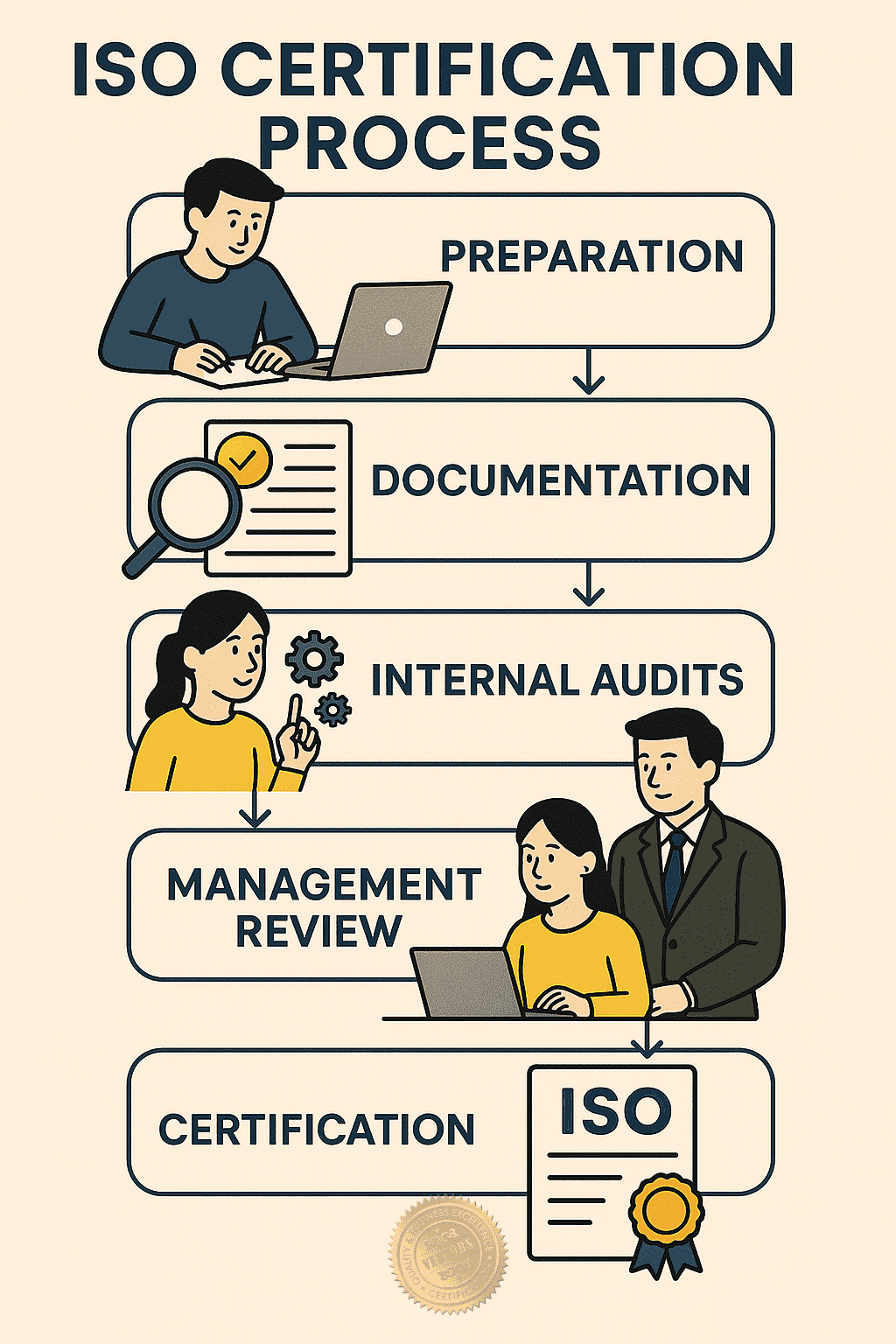
- Gap Assessment — We evaluate your current system against every applicable AS9100/AS9120 requirement and deliver a prioritised action plan. (See our Gap Analysis service.)
- Planning — A realistic project plan with responsibilities, milestones, and resource requirements, typically spanning 90–120 working days to certification readiness depending on organisational maturity.
- Documentation Development — Quality manual, procedures, work instructions, and records aligned to your actual processes — lean documentation that people use, not shelf-ware.
- Implementation — Embedding the documented system into daily operations: configuration control, traceability, supplier management, and counterfeit-parts prevention working in practice.
- Employee Training — Role-based awareness and competence training, from leadership briefings to shop-floor sessions, through Vektors Academy.
- Internal Audit — A full-system internal audit by trained auditors, identifying and correcting nonconformities before the certification body arrives.
- Management Review — A structured review generating the leadership evidence AS9100 demands.
- Certification Audit Support — We coordinate with your chosen accredited certification body, support you through Stage 1 and Stage 2 audits, and assist with closure of any findings.
- Continual Improvement — Post-certification surveillance support, ongoing internal audits, and system maturation — including preparation for the forthcoming IA9100 transition.
Why Choose Vektors as Your AS9100 Consultant
- 24+ years of management systems consulting experience across quality, business excellence, sustainability, and international standards.
- Industry-specific consultants with hands-on aerospace, engineering, and manufacturing backgrounds — implementation guidance grounded in practice, not theory.
- Practical, business-focused delivery — systems designed to improve operations and win contracts, not merely to pass audits.
- Independence preserved — Vektors provides consulting, training, and internal audit services and facilitates certification through accredited certification bodies; we do not certify our own consulting work, protecting the integrity of your certificate.
- Cost-effective engagement models suited to start-ups and SMEs as well as established manufacturers.
- International reach — services delivered across India (PAN-India) and internationally through our Mumbai and Dubai offices, spanning the GCC, Africa, and Southeast Asia.
- Training capability — internal auditor and awareness training delivered through Vektors Academy.
- Turnkey support — from first gap assessment to certificate in hand, and beyond into surveillance cycles.
Frequently Asked Questions
- What is AS9100? AS9100 is the international Quality Management System standard for aviation, space, and defence organisations, developed by the IAQG and published by SAE International. The current edition, AS9100D, incorporates ISO 9001:2015 in full and adds aerospace-specific requirements such as product safety, configuration management, and counterfeit parts prevention.
- What is AS9120? AS9120 is the aerospace QMS standard for stockist distributors — organisations that procure and sell aerospace parts without altering them. The current edition is AS9120B.
- Is AS9100 mandatory? No law mandates AS9100. In practice, however, aerospace primes, defence buyers, and Tier-1 suppliers routinely require or strongly prefer certified suppliers, making it a commercial necessity for serious aerospace market participation.
- Does my drone company need AS9100? If you supply defence customers, aerospace primes, or export markets — or intend to — AS9100 is increasingly expected. Leading global UAS manufacturers hold it, and India’s largest listed drone maker operates an AS9100D-certified facility. For purely consumer drones, ISO 9001 may suffice initially.
- Is AS9100 applicable to UAV and UAS manufacturers? Yes, fully. UAVs are aviation products within AS9100’s stated scope of aviation, space, and defence, and the standard’s requirements map directly onto drone design, production, and support.
- What industries require AS9100? Aircraft and UAV manufacturing, aerospace components and assemblies, avionics and aerospace electronics, composites, precision machining, special processes (heat treatment, surface treatment), additive manufacturing, satellite and launch-vehicle components, and defence equipment manufacturing.
- Who should obtain AS9120 certification? Aerospace parts distributors, stockists, traders, importers/exporters, and warehousing or logistics providers handling aerospace hardware without altering it.
- What is the difference between AS9100 and ISO 9001? AS9100 contains all of ISO 9001 plus roughly 100 aerospace-specific additions — product safety, configuration management, counterfeit parts prevention, first article inspection, and stricter supplier control — with certification overseen by the aerospace industry’s own ICOP scheme.
- What is the difference between AS9100 and AS9120? AS9100 is for organisations that design or manufacture aerospace products; AS9120 is for distributors that buy and sell them unchanged. AS9120 excludes design requirements and concentrates on traceability, preservation, and counterfeit prevention in distribution.
- How long does AS9100 certification take? Most organisations achieve certification readiness in 90–120 working days of structured implementation, followed by the certification body’s Stage 1 and Stage 2 audits. Complex, multi-site, or design-intensive organisations may need longer.
- What does AS9100 certification cost? Costs comprise consulting/implementation, training, and certification body fees, and vary with organisation size, sites, scope, and existing system maturity. Vektors provides a transparent techno-commercial proposal after understanding your scope — request one here.
- Can small businesses and start-ups obtain AS9100? Yes. The standard scales to organisation size, and lean implementations are entirely achievable. Many drone and defence start-ups certify with small teams; what matters is disciplined processes, not headcount.
- What is the IAQG? The International Aerospace Quality Group is the global association of aerospace companies that develops and governs the 9100 series of standards and operates the ICOP certification oversight scheme and the OASIS supplier database.
- What is the OASIS database? The IAQG’s Online Aerospace Supplier Information System — the public register of all organisations certified under the ICOP scheme. Aerospace buyers use it to verify supplier certification status.
- What is AS9110, and do MRO organisations need it? AS9110 is the 9100-series standard for aerospace maintenance, repair, and overhaul organisations. Drone and aviation MRO providers should certify to AS9110 rather than AS9100.
- Does AS9100 cover software? Yes. Software developed as part of, or embedded in, aerospace products falls within the QMS — including requirements definition, design reviews, testing, configuration control, and release management. Customer contracts may additionally invoke assurance standards such as DO-178C.
- How does AS9100 help with DGCA drone type certification in India? DGCA type certification under the Drone Rules 2021 requires design data, configuration control, traceability, and test evidence — exactly the records an AS9100 system generates as a matter of routine. Implementing AS9100 substantially prepares the type-certification file.
- What is counterfeit parts prevention under AS9100 and AS9120? Both standards require planned processes to prevent counterfeit or suspect parts entering products or supply chains: trusted sourcing, documentation verification, detection, quarantine, and reporting. AS5553 provides detailed companion guidance for electronic parts.
- What is first article inspection (FAI)? A complete, documented verification of the first production item against all engineering requirements, performed per AS9102, to prove the production process before rate manufacture.
- What is configuration management and why does it matter for drones? It is the discipline of controlling a product’s identity, baseline, and changes. Drone platforms iterate rapidly across hardware, firmware, and payload variants; configuration management ensures every delivered aircraft’s exact build state is known, reproducible, and supportable.
- Do heat treatment, plating, or composite shops need AS9100? Yes, when serving aerospace customers. These “special processes” are high-risk because their results cannot be fully verified by later inspection; aerospace buyers expect AS9100 certification and often Nadcap process accreditation in addition.
- Is AS9100 recognised internationally? Yes. AS9100, EN 9100, and JISQ 9100 are technically identical, and ICOP certification is recognised across the Americas, Europe, and Asia-Pacific — one certificate serves global markets.
- What is IA9100 and when is it coming? IA9100 is the forthcoming revision and rebranding of the 9100 series, aligned with ISO 9001:2026 and targeted for publication in late 2026, with a two-to-three-year transition expected. Certifying to AS9100D now positions you to transition smoothly through routine audit cycles.
- Can AS9100 be integrated with other standards we hold? Yes. AS9100 shares the ISO high-level structure with ISO 14001, ISO 45001, and ISO/IEC 27001, enabling an integrated management system. Vektors regularly implements integrated systems spanning quality, environment, safety, and information security.
- We already have ISO 9001. How big is the step to AS9100? Meaningful but manageable. Your ISO 9001 foundation remains valid; the upgrade adds aerospace requirements — product safety, configuration management, counterfeit prevention, FAI, enhanced supplier control — and adapts existing processes to aerospace rigour. A gap assessment quantifies the exact distance.
- Who audits and certifies organisations to AS9100? Only certification bodies accredited under the IAQG ICOP scheme, using authenticated aerospace auditors. Vektors, as your consultant, prepares you for that audit and supports you through it — maintaining the essential independence between advisory and certification roles.
- What happens after certification? Annual surveillance audits and three-yearly recertification. Vektors offers ongoing internal audit, training, and improvement support to keep the system healthy and audit-ready — and to prepare for the IA9100 transition.
- How do we become an approved aerospace supplier? Typically: implement an AS9100/AS9120-conformant QMS, achieve certification and OASIS listing, then satisfy each customer’s supplier-approval process (questionnaires, audits, flow-down acceptance). Certification is the foundation on which customer approvals are built.
Ready to Enter the Aerospace Supply Chain?
Whether you are a drone start-up preparing for your first defence tender, a precision engineering company targeting aerospace customers, or a distributor formalising your traceability system, the path to AS9100 or AS9120 certification is shorter and surer with an experienced partner.
Talk to Vektors today about: Gap Assessment • Implementation • Documentation • Internal Audits • Auditor Training • Certification Support
Request a Techno-Commercial Proposal → Call: +91-9820444925 | Email: hi@vektors.in | Mumbai • Dubai • PAN India • International